01
CVSS only prioritization
Severity scores lack endpoint exposure, weaponization, and business context. Teams spend scarce maintenance windows on vulnerabilities that may not represent the highest real world risk.
Enterprise AI Platform · 25 Products
Explore productsContinuously discover, prioritize, and deploy patches across your entire enterprise infrastructure with zero manual orchestration.
XpediOo combines live patch visibility, business aware risk scoring, safe rollout rings, and complete governance in one operational workflow.
Severity scores lack endpoint exposure, weaponization, and business context. Teams spend scarce maintenance windows on vulnerabilities that may not represent the highest real world risk.
Disconnected scanners, endpoint tools, and deployment systems create stale data and a dangerous gap between identifying a CVE and verifying its remediation.
Without automated discovery, shadow IT, transient remote devices, and unmanaged endpoints remain outside the patch scope even when deployment tooling is effective.
A successful command is not proof of remediation. Pending reboots, configuration conflicts, and failed installs can leave an endpoint vulnerable after the job reports success.
Continuous discovery through native agent telemetry and agentless scanning
Threat informed priority using CISA KEV, CVSS, EPSS, patch age, and business context
Explainable AI with visible score components, rank changes, and analyst overrides
Governance first automation with independent approval for high risk exceptions
Closed loop verification that proves the vulnerable state was actually mitigated
Honest reporting that exposes unknown, stale, managed, and noncompliant segments
Identify managed, remote, transient, and unmanaged infrastructure so every subsequent stage works from a complete data set.
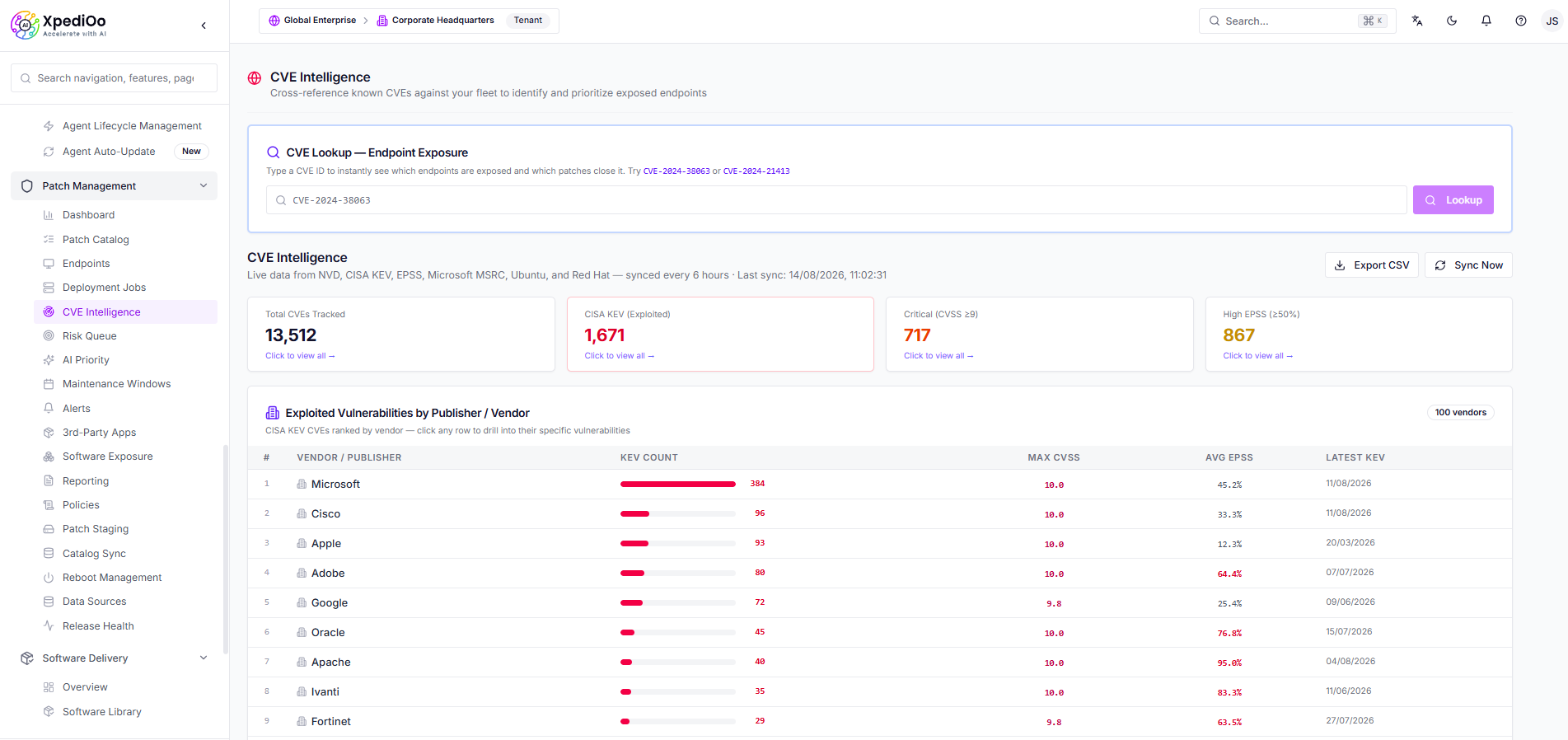
Connect patch and CVE intelligence to software identity, endpoint metadata, asset criticality, exposure, and known exploitation activity.
Generate an explainable, rank ordered remediation list that shifts as threat intelligence, asset importance, and patch age change.
Validate applicability, content integrity, dependencies, disk space, service state, and representative pilot targets before release.
Deliver through policy driven maintenance windows and deployment rings with evidence gates, throttling, retries, and automatic failure holds.
Run post change telemetry and active vulnerability checks, reconcile the before and after state, and return unresolved devices to the action queue.
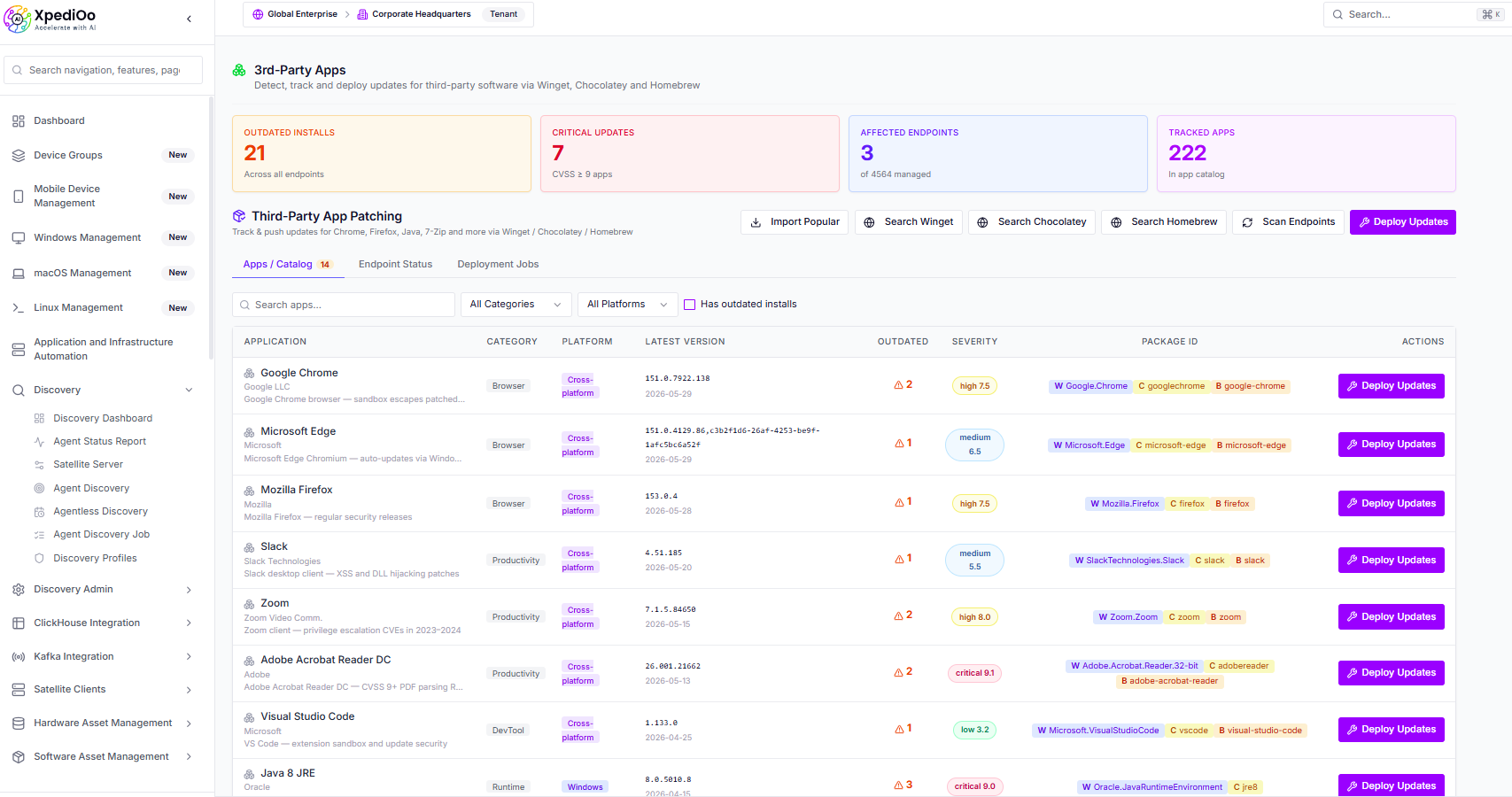
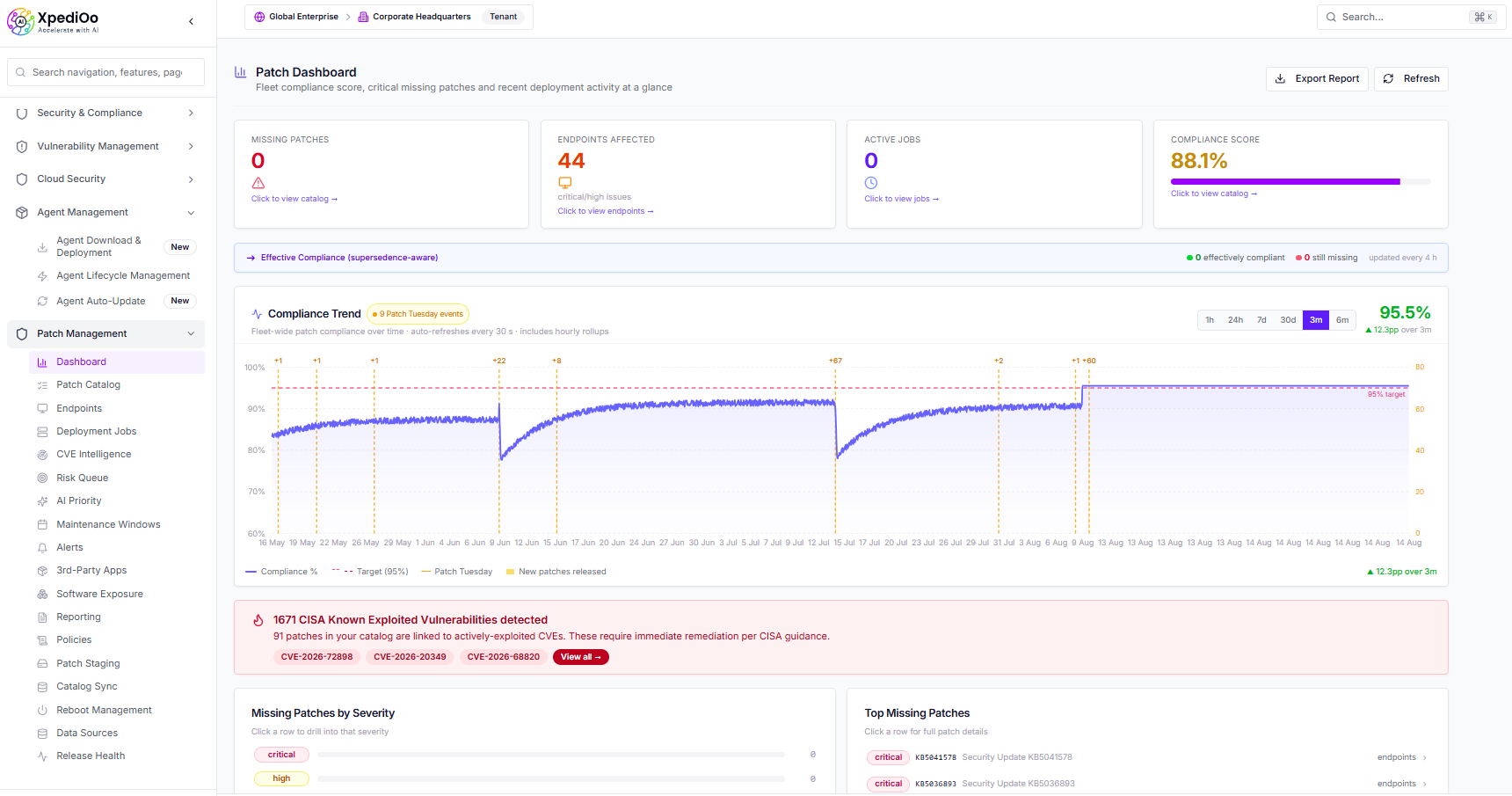
Integrate Windows Update Agent intelligence, KB level telemetry, pending reboot state, vulnerability context, ring based deployment, and post change verification.
Treat browsers, runtimes, productivity tools, and collaboration software as part of the same risk based program instead of leaving the practical exploitation surface unmanaged.
Apply one accountability model across native update frameworks, MDM profiles, package repositories, server clusters, and workstation workflows.
XpediOo weighs technical severity, exploitation probability, confirmed activity, exposure, criticality, and patch age to produce actionable order.
Measures potential impact, but does not describe the full environmental risk on its own.
Adds a probability signal for how likely a vulnerability is to be exploited in the wild.
Elevates vulnerabilities known to be used by threat actors into an accelerated remediation tier.
Connects the vulnerability to affected endpoints, owners, sites, services, and asset criticality.
Amplifies vulnerabilities that remain unpatched despite an available fix, preventing forgotten exposure from accumulating.
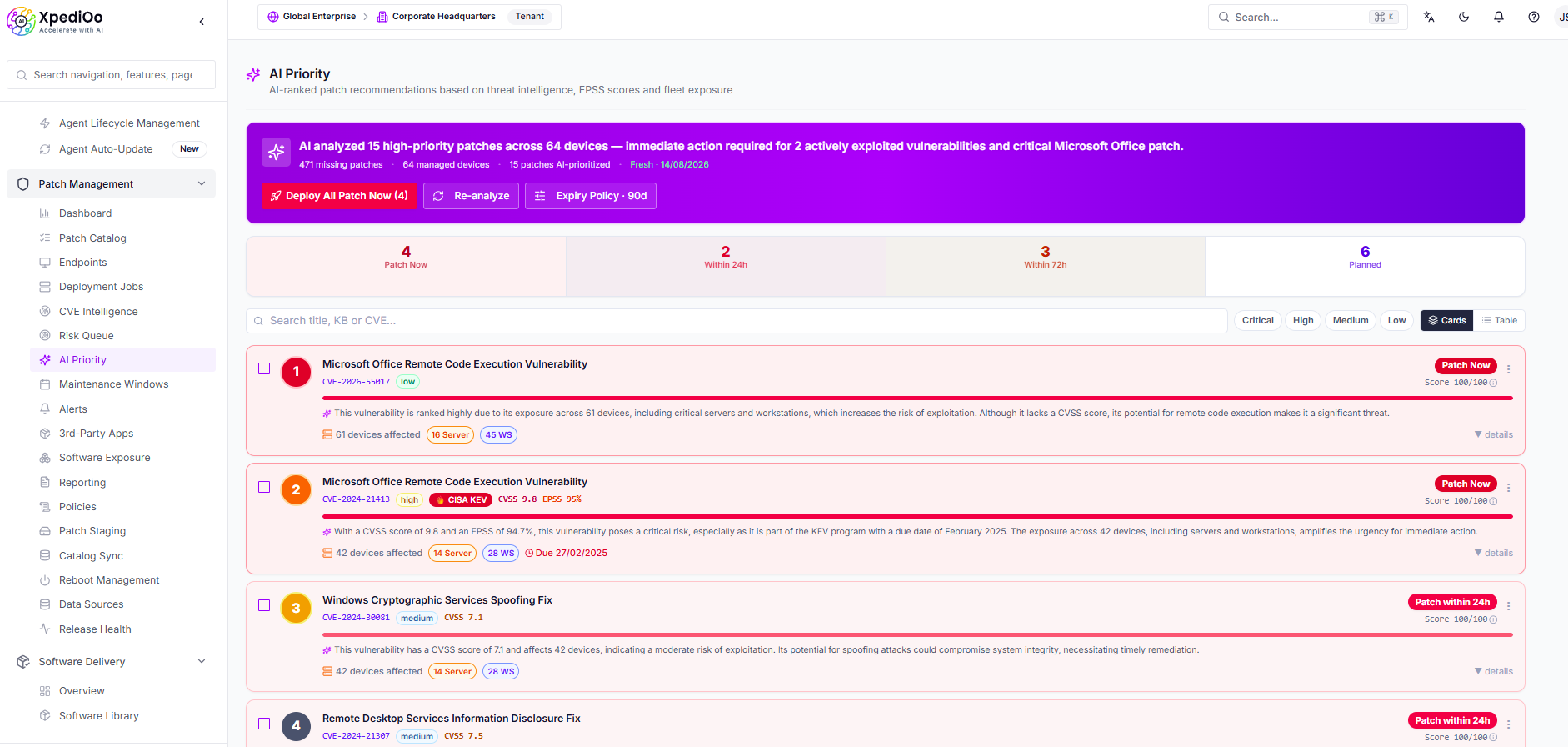
Every rank exposes the contribution of CVSS, EPSS, KEV, exposure, asset criticality, and data freshness. Rank change indicators show what moved the recommendation.
Known exploited vulnerabilities require accelerated timelines, independent second party approval, management visibility, hard expiry dates, and tamper evident audit history.
Map asset classes, service criticality, severity, and KEV status to reproducible SLA tiers that are reviewed as the business and threat landscape change.
Representative pilots, evidence gates, staggered sites or business units, and automatic failure holds limit blast radius without sacrificing security velocity.
Classify maintenance windows by asset class, manage reboot impact, accelerate KEV windows, and record technical blockers instead of allowing silent deferrals.
Validate package provenance, signatures, hashes, applicability, dependencies, bandwidth, regional distribution points, and preflight readiness before release.
Give every campaign a unique job identity, policy binding, execution state, idempotent retry behavior, and per device outcome evidence.
Distinguish installed, pending reboot, blocked, unknown, and remediated states through active post change scans and immutable evidence retention.
Require owners, justification, compensating controls, expiry, closure conditions, escalation, and audience specific evidence views for every deferred risk.
Synthesize patch posture, compliance gaps, hardware health, and user behavior anomalies into a transparent risk view.
Map endpoint configuration against CIS Benchmarks, NIST CSF, and ISO 27001 to generate prioritized remediation playbooks.
Compare endpoints with known good baselines, classify deviations, and suggest changes while keeping human approval in the loop.
Use historical usage telemetry to recommend reboot and maintenance windows that improve success rates and reduce user disruption.
Generate executable recommendations with confidence scores as a bridge from vulnerability identification to controlled deployment.
Give help desk teams device and policy context while producing executive ready briefings from governed operational data.
AI Powered Patch Management builds a live inventory of missing, superseded, failed, and successfully deployed patches across the enterprise. It normalizes vendor advisories and package metadata into a single operational view.
Instead of treating every available update equally, the platform combines technical severity with real business context. Teams get a ranked action list that reflects exposure, service criticality, device importance, and deployment readiness.
Every deployment can move through controlled rings so teams can validate results before expanding across the fleet. Automated gates pause campaigns when failure rates, performance signals, or user impact thresholds are exceeded.
Patch campaigns remain fully traceable from approval through completion. Compliance leaders can see coverage, overdue assets, approved exceptions, and evidence for every reporting period.
Deploy telemetry across the primary workstation population to validate coverage, data quality, and inventory visibility without changing endpoint configurations.
Import standards such as CIS Benchmarks and run the compliance engine in Audit Only mode to measure the gap between current state and policy targets.
Select a noncritical cohort and require human approval for each automated patch cycle while the organization validates the recommendation engine.
Add third party catalogs and server populations, then automate risk based prioritization across the global estate.
Define repeatable, time bound exception workflows with automatic expiry and clear ownership.
Use trend data and AI refinement cycles to optimize patch intervals, reduce downtime, and lower the attack surface.
A feature comparison is not an evaluation. A rigorous proof of concept uses real endpoints, real vulnerabilities, and real governance requirements.
Coverage qualityDistinguish current, stale, unknown, and unmanaged assets.
PrioritizationCompare AI recommendations with analyst judgment and verify KEV identification.
GovernanceTest independent KEV exception approval and traceability in reporting.
DeploymentTest pilot rings, maintenance windows, failure handling, retries, and content delivery.
VerificationProve which endpoints are remediated and which remain vulnerable.
Commercial fitEvaluate catalog depth, integrations, services, and total operating cost.
Establish a comprehensive baseline before deployment, then quantify the change in risk reduction and operational efficiency.
Reduce time from intelligence ingestion to prioritized action, critical and KEV exposure age, and risk on critical assets.
Improve first time deployment success, reduce failed deployment diagnosis time, and lower campaign preparation effort.
Increase exception completeness and independent approvals while reducing audit evidence retrieval time.
Track open critical exposures, risk concentration across business services, and time to produce executive ready briefings.
A focused discovery workshop and structured proof of concept deliver more value than a demo. Start with the current estate, then prove the complete operating loop.
Review endpoint diversity, patch cadence, service dependencies, KEV exposure, exceptions, and reporting pain points.
Test an urgent KEV response, a routine patch campaign, and a contested policy exception on representative endpoints.
Map SIEM, ITSM, CMDB, and identity integrations while aligning security, operations, risk, finance, and procurement stakeholders.